
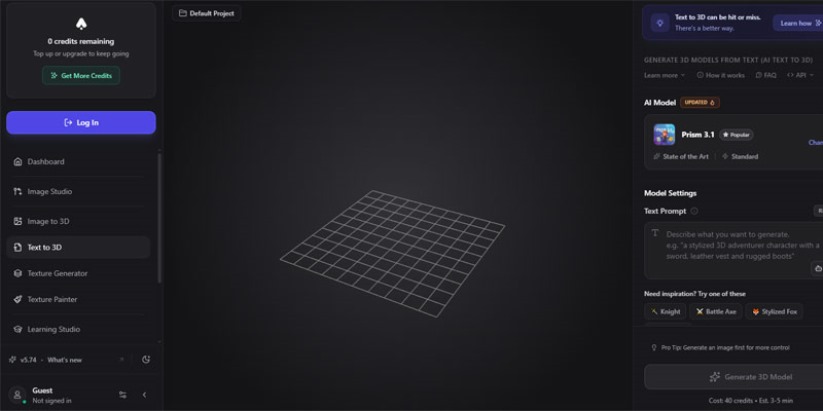
Text-to-3D changes how designers think about iteration. Go from concept sketch to 3D validation in minutes, not weeks.
The design process is fundamentally about iteration. You sketch, you iterate, you test, you refine. Each cycle reveals something new about the problem you're solving.
The bottleneck has always been time. A designer sketches a logo concept in 2D. To see how it looks in 3D, they either:
- Hand it off to a 3D artist (adds days to the timeline)
- Learn 3D tools themselves (adds weeks to their skillset)
- Iterate in 2D and hope the 3D version will work (often it doesn't)
Each option has friction. Each option delays the design process.
What if the sketch-to-3D jump didn't require days, weeks, or hope? What if a designer could go from concept to 3D model in minutes?
That's the shift that textto 3D model generator is creating.
The Design Workflow Evolution
Design tools have evolved in predictable patterns. First, tools optimize speed (draw faster). Then, tools optimize quality (draw better). Then, tools abstract away complexity (draw without knowing how).
Photoshop optimized speed for 2D composition. Figma optimized collaboration. Blender optimized quality for 3D.
Text-to-3D generation optimizes abstraction. You describe the thing you want to make. The tool makes it. The designer focuses on creative direction, not on technical execution.
This is the first major shift in how designers think about 3D in a decade.
Where the Friction Currently Is
A designer at a product company wants to visualize a new packaging concept. The sketch exists in 2D. The packaging will exist in 3D.
The designer has options:
Option A: Commission a 3D artist. Cost: $500–$2,000 for a basic 3D model. Timeline: 3–7 days. The designer briefs the artist, the artist interprets, there's back-and-forth. By the time the 3D model comes back, the original concept might have evolved and the 3D is already outdated.
Option B: Learn 3D software. Cost: 100+ hours to become competent in Blender or similar. This is a massive lift for a 2D designer who just wants to see if the concept works in 3D.
Option C: Use a 3D asset library. Cost: $20–$100 for pre-made 3D assets. The challenge: your concept is specific. The library asset is generic. You spend 2 hours trying to modify a generic model to match your concept.
Option D: Iterate in 2D and hope. Cost: zero. Timeline: immediate. The catch: you launch a product based on a 2D concept and discover it doesn't work in 3D. Now you're fixing it in production.
All four options have compromises. None of them feel right for the creative process.
What Text-to-3D Changes
Text-to-3D generation short-circuits the friction. A designer describes the concept: "A curved, minimalist packaging box with a matte finish and subtle texture."
The tool generates a 3D model. Not perfect. Not production-ready. But good enough to see whether the concept works in 3D. In minutes, not days.
If the concept works, the designer refines it: "More rounded at the corners. The texture should be subtle. Make the top edge beveled."
The tool regenerates. Another minute.
If the concept doesn't work, the designer pivots: "Actually, let's try a rectangular form instead of curved."
Another iteration. Another minute.
In 30 minutes, the designer has explored 5–10 variations and validated whether the concept is viable in 3D. A traditional workflow would have taken a week.
How This Changes Design Thinking
When iteration is fast and cheap, designers think differently.
Instead of planning every detail before handing off to a 3D artist, designers can explore. They can ask "what if we made this taller?" and see the answer immediately. They can ask "what if we added a pattern here?" and visualize it instantly.
This is the same shift that happened when digital tools replaced pen-and-paper for 2D design. Iteration became cheaper. Designers became more exploratory. Better designs emerged from the speed of iteration.
Text-to-3D is democratizing 3D exploration for 2D designers. It's not replacing 3D artists. It's giving designers the ability to explore 3D space without requiring specialized skills.
The Use Cases Where This Lands Hardest
Product design. Packaging, hardware, industrial design—all benefit from fast 3D iteration. A designer can sketch a form, generate a 3D model, and validate whether it's manufacturable and aesthetically coherent.
Architecture and interior design. Architects can describe a spatial concept ("An open-plan office with curved walls and natural light") and generate visualizations that clients can understand without waiting for a 3D render.
Game asset prototyping. Game designers can describe environmental assets ("A weathered wooden crate, 1m x 0.5m, with metal straps") and generate 3D models that can be imported into game engines and iterated further.
Branding and packaging. A designer can visualize how a logo works on a 3D object (a bottle, a box, a billboard) without commissioning a 3D mockup.
Fashion and product visualization. A fashion designer can describe a garment and see how it drapes and looks in 3D, informing whether the concept is wearable.
In each case, the tool solves the same problem: making 3D exploration fast and accessible to designers who don't specialize in 3D.
The Quality Question: Is It Good Enough?
Text-to-3D generation is not (yet) production-ready for most professional applications. The models are approximations. They lack detail. They sometimes have geometric artifacts.
But "good enough to explore" is the right threshold for design thinking. You're not using the generated model as a final asset. You're using it as a rapid prototype to validate whether the concept works.
Once the concept is validated, you can:
- Hand the validated concept to a 3D artist for refinement
- Use the generated model as a base and modify it in 3D software
- Commission a final model with confidence that the direction is right
The tool accelerates the thinking part. The 3D artist handles the execution part.
This division of labor is more efficient than the old workflow where the 3D artist had to interpret a 2D sketch with no visibility into the designer's thinking.
The Workflow Integration
The best use of text-to-3D isn't as a replacement for 3D artists. It's as a layer in the design workflow:
- Conceptual exploration (2D): Designer sketches 2D concepts, tests layouts, validates direction
- 3D validation (text-to-3D): Designer generates 3D models to validate concepts work in 3D space
- 3D refinement (3D software or commissioned): For validated concepts, designer refines in 3D software or briefs a 3D artist with a clear direction
- Final production (3D assets): Polished, production-ready 3D assets for marketing, manufacturing, or deployment
Text-to-3D fits between 2D and 3D, solving the validation problem. It doesn't replace 3D artists. It makes them more efficient because they're working from validated concepts, not from ambiguous 2D sketches.
The Skill Shift: From Tools to Direction
As text-to-3D tools improve, the skill that matters isn't "can you use 3D software." It's "can you describe what you want."
This is a profound shift. A designer who's spent 10 years mastering Blender is suddenly competing with a designer who spent 10 years learning to describe concepts clearly.
The tool flattens the technical barrier. The creative and conceptual skills become more valuable.
This is healthy for design. It means more ideas can be explored. Better thinking wins, not better tool proficiency.
What This Means for Design Teams
For studios and agencies, text-to-3D changes staffing economics:
- You need fewer 3D specialists handling exploratory work
- You need more versatile designers who can iterate across 2D and 3D
- The 3D specialists you do hire can focus on refinement and production-quality assets
The total amount of 3D work might increase (because designers can explore more), but the distribution of work shifts from specialized 3D artists to broader design teams.
For freelance designers, it's an opportunity. The ability to offer 3D concepts to clients (something that previously required partnering with a 3D artist) becomes a competitive advantage.
The Limitation: Complexity and Customization
Text-to-3D is best for forms and objects. It's less effective for scenes, complex environments, or highly specific customizations.
If you need a simple box? Generate it in 30 seconds. If you need a fantasy landscape with 47 custom environmental details? Text-to-3D will give you a start, but you're still in 3D software for hours refining.
The tool is best for the 60% of design work that's exploratory and conceptual. The remaining 40% (production-quality refinement) still requires 3D software or specialized artists.
What This Means for Your Design Process
If you're doing any 3D work—packaging, product visualization, architectural rendering, game asset conceptualization—text-to-3D tools should be in your workflow.
You're not replacing your 3D artist or your 3D software. You're adding a rapid-exploration layer that makes your design thinking faster and your briefs to 3D specialists clearer.
The designers who adopt this shift first will be the ones producing more iterations, exploring more directions, and landing on better ideas faster.
That's where the competitive advantage is.